Enabling Non-Persistent User Differentiation in Frequency-Division Capacitive Multi-Touch Sensors
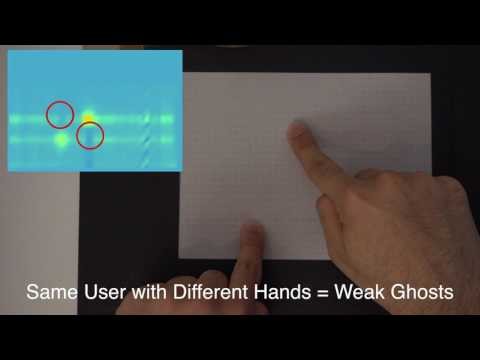
Current touch devices are adept at tracking finger touches, but cannot distinguish if multiple touches are caused by different fingers on a single hand, by fingers from both hands of a single user, or by different users. This limitation significantly reduces the possibilities for interaction techniques in touch interfaces. We present GhostID, a capacitive sensor that can differentiate the origins of multiple simultaneous touches. Our approach analyzes the signal ghosting, already present as an artifact in a frequency-division touch controller, to differentiate touches from the same hand or different hands of a single user (77% reliability at 60 fps) or from two different users (95% reliability at 60 fps). In addition to GhostID, we also develop a framework of user-differentiation capabilities for touch input devices, and illustrate a set of interaction techniques enabled by GhostID.(Sahdev et al., 2017)
References
2017
CHI
GhostID: Enabling Non-Persistent User Differentiation in Frequency-Division Capacitive Multi-Touch Sensors
Sidharth Sahdev, Clifton Forlines, Ricardo Jota, and 6 more authors
In Proceedings of the 2017 CHI Conference on Human Factors in Computing Systems, Denver, Colorado, USA, 2017
Current touch devices are adept at tracking finger touches, but cannot distinguish if multiple touches are caused by different fingers on a single hand, by fingers from both hands of a single user, or by different users. This limitation significantly reduces the possibilities for interaction techniques in touch interfaces. We present GhostID, a capacitive sensor that can differentiate the origins of multiple simultaneous touches. Our approach analyzes the signal ghosting, already present as an artifact in a frequency-division touch controller, to differentiate touches from the same hand or different hands of a single user (77% reliability at 60 fps) or from two different users (95% reliability at 60 fps). In addition to GhostID, we also develop a framework of user-differentiation capabilities for touch input devices, and illustrate a set of interaction techniques enabled by GhostID.